How to play
Six steps per dumpling, and no "Next" button. Where your finger goes down decides whether you scoop filling, moisten, fold, pleat or carry it off. Within the time limit, the more good dumplings you wrap and the neater the pleats, the higher your score.
Look first, then let go. When scooping you can see how much filling is on the spoon, moistened edges turn darker, and a pleat shows a preview when you press and only presses down when you let go. If you press the wrong thing, there is usually still time to undo it.
The first dumpling of every round gets suggested spots. Once the folded dumpling stands up, 7 faint circles appear along the seal (one in the middle, three on each side) and disappear when you press them. They don't show for the dumplings after that.
Making one dumpling
Once you set one on the tray, the next wrapper is passed over automatically. Every step has consequences, but most can be undone first.
- 1
Scoop
Press and hold the filling bowl while the spoon fills up, then drag to the middle of the wrapper and let go.
UndoLet go off the wrapper and it tips back into the bowl
RiskToo much bursts; off-center smears the seal
- 2
Moisten
Tap the water bowl to wet your finger, then tap the wrapper and your finger runs water along half the edge. Moistened spots turn darker. You can also drag from the bowl and trace the edge yourself.
UndoMissed a bit? Dip again and tap the wrapper
RiskDry spots slowly spring back open when pleated
- 3
Fold
Press the lower half of the wrapper and slide up to fold it over. Once closed it stands up on its own and the camera moves in.
UndoLet go before halfway and the wrapper springs back
RiskAfter folding, no more filling or water
- 4
Middle first
Press the middle of the seal first to pin the two halves together. This is the first pleat and the reference for left-right symmetry.
UndoSlide off the seal before you let go to cancel
RiskSkip it and the crescent skews, losing points
- 5
Pleat out
From the middle out to both sides, press along the seal one spot at a time, one press per pleat. Several fingers can press at once; hold a single finger for a moment and a magnifier circle appears above it.
UndoPressed on release; slide off the seal to cancel
RiskUneven spacing costs points; far apart leaves gaps
- 6
Onto the tray
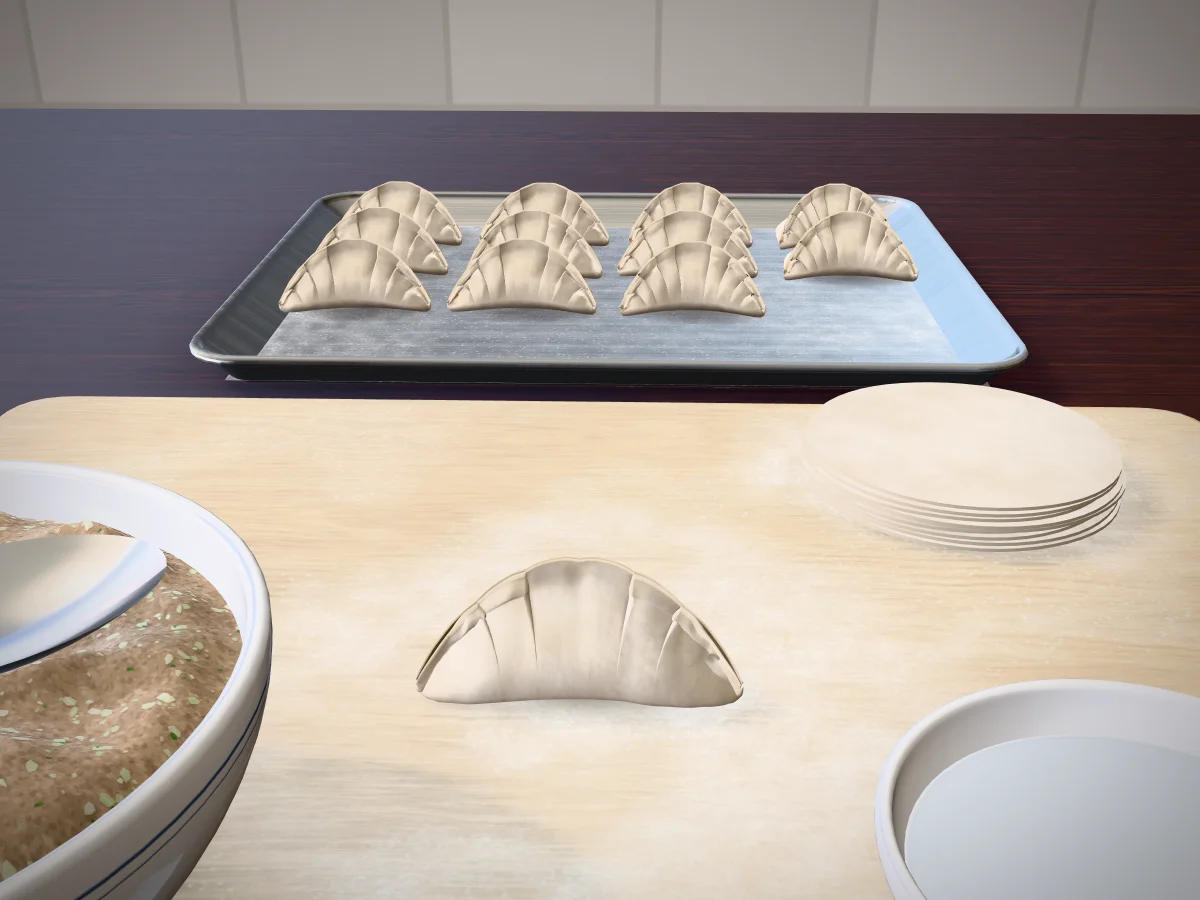
Press the dumpling and drag it up onto the floured tray. Let go and this one is done.
UndoPut it back on the board to keep pleating
RiskSticking to a neighbor costs points; a drop is a defect
Controls
Pleats can take several fingers at once. Every other step uses one finger only, and a long press never brings up text selection or a magnifier. How hard you press makes no difference, only where and how many times.
Pleats press on release. Pressing shows a preview pleat, holding a moment brings up a magnifier circle you can slide to fine-tune the spot, and letting go presses it down for real. Slide off the seal and it's canceled, so that press doesn't count.
If the seal has a gap, the screen reminds you to press it again. A gap shows a bit of filling, and one more press on it fixes it. But press the same spot a 3rd time and the wrapper tears.
No hand is drawn on screen. There's only a fingertip shadow, so your hand never covers the spot you want to press.
Scoring
Your total is the quality of every good dumpling added up. Quality tops out at 100, but a good dumpling is always worth at least 30, so speed always helps. In the same time, neat wrapping earns far more. Defects score 0 and are not counted.
For example: in 60 seconds you wrap 9 good dumplings and 2 defects (an open seal and a burst). The 9 good ones' quality adds up to 819, so your score is 819.
Defects
A dumpling that would fall apart in the pot is a defect. A small tag with the reason pops up the moment you set it on the tray, and on the results card you can tap that dumpling to see what went wrong.
- Open sealA stretch of the seal longer than 0.9 cm (about a fingertip) is left unsealed.
- TornPressing the same spot a 3rd time tears the wrapper.
- BurstToo much filling (over 26 g), or over 22 g placed too close to the wrapper edge, so it squeezes out of the seal when folded.
- EmptyFolded with less than 3 g of filling on the wrapper, so all you end up with is a folded wrapper.
- Not foldedTaking it to the tray while the wrapper is still flat.
- DroppedLetting go anywhere but the tray drops it onto the table.
Quality of good dumplings
Anything not defective is a good dumpling. The moment it lands on the tray, it is scored out of 100 on six points:
- Seal30 ptsThe more of the edge that's sealed, the better. A pleat pressed onto a dry edge slowly springs back open, −4 pts for each one.
- Spacing25 ptsThe more even the gaps between neighboring pleats, the better: within 10% of even is full marks, and 30% or more off leaves just 7.5 pts. With fewer than 4 pleats, this score is halved.
- Filling15 ptsWithin 5% of 15 g is full marks, and 30% off scores zero.
- Symmetry10 ptsThe middle pleat acts as a mirror: do the pleats on the left and right line up? Each pleat of difference between the sides costs 3 pts. With fewer than 4 pleats, this score is halved.
- Shape10 ptsToo little filling, so it looks flat: −4 pts. Filling off to one side: −3. Middle not pressed first: −3. The two sides closed by different amounts: −2.
- Clean10 ptsFilling smeared on the seal: −5 pts. Sticking to the dumpling next to it on the tray: −5.
Bonus: 4 to 8 pleats lose nothing, and 9 or more (not counting the middle press) earn 3 more pts. A single dumpling tops out at 100.
Three time limits
Pick 60, 90 or 120 seconds before you start, then a 3-second countdown. Each time limit keeps its own best score, separate from the others.
When time is up, a dumpling in your hand that is already sealed and only needs setting down goes onto the tray automatically and is scored. One that isn't sealed yet doesn't count.
After time is up, the dumplings on the tray go into the pot for 3 seconds (not counted in your time): sealed ones float, open ones leak filling, and burst ones split. Then the results appear, along with how many you would wrap in an 8-hour day at that pace.
QC stamp
A stamp lands on the results card, depending on how many of your dumplings were defects:
- QCPASSAt most 1 defect, or a defect rate of 10% or less
- QCREWORKA defect rate of 20% or less
- QCFAILAnything else, including when none passed
Ranks
Based on how many good dumplings you wrap per minute. All three time limits use the same thresholds, so ranks at 60 and 120 seconds are fair. The top two ranks also need a good average quality, so you can't win by rushing sloppy ones.
Fun facts
Store-bought dumpling wrappers are mostly 7 to 8.8 cm across. The game uses 8 cm, which is also the round wrapper in Taiwan's national skills exam for dumplings.
You really do have to moisten. Store-bought wrappers need a little water on the edge to stick, and anywhere you skip, the pleat slowly springs back open. Hand-rolled wrappers usually don't need it.
More filling isn't always better. A Taiwanese dumpling usually holds 15 to 20 g of filling, and the skills exam sets the wrapper to filling ratio at 2 to 3. Too much squeezes out, too little looks flat.
Press the middle first, then work outward. After folding, pinch the exact middle shut to fix it in place, then pleat left and right so the crescent doesn't skew. A common way is 2 to 4 pleats a side, 4 to 8 in all.
An open seal ruins a dumpling, while a bit crooked just looks bad. The skills exam counts an open seal as a fault, and contests count only good dumplings. Uneven pleats, a little skew or a little flat cost a few points at most.
Dust the tray and keep them apart. Finished dumplings sit on a tray with a thin layer of flour, one at a time, so they don't stick together.
Real people aren't this fast. Timed home cooks took 23 to 36 seconds per dumpling. The game skips rolling the wrappers and mixing the filling, which is why you can wrap several in 60 seconds. Reports on professionals mostly say 2 to 8 seconds each.
Numbers come from public Taiwan skills exam and recipe data. The game's judging is simplified.